Showing posts with label Cutting Edges. Show all posts

Thursday, 28 April 2016

Cutting Edges - The Sixth Sens (1999) - Film Review

The Sixth Sense (1999) is an American production which caused a great impact on the audience, being the best film by screenwriter and film director M. Night Shyamalan.

The Sixth Sense Poster - the-sixth-sense Photo

Shyamalan’s The Sixth Sense stands out because of its simple shots, because of its simple but at the same time complex story, and because of the excellent main characters. Apart from Bruce Willis, the movie stars Haley Joel Osment,  who has made maybe the greatest performance ever by a child actor. “The 11-year-old Osment evokes the boy’s terror and awful predicament so memorably, you’ll never forget him” (Desson Howe, 1999)
The story begins with Bruce Willis in the role of Dr. Malcolm Crowe. Crowe is a child’s psychologist who lives completely to his job, and despite his great achievements he is obsessed with the painful memory of a young patient he was unable to help. Several months later, Crowe has a chance to help Cole (Haley Joel Osment), a terrified and confused eleven year old boy whose background reminds him of his only case failed. Meanwhile, Crowe’s private life is a mess, and his marriage with Anna (Olivia Williams) turns out to be a cold and a distant relationship, and he cannot  do anything to solve it.

thesixthsense

The Sixth Sense has a kind of calm, sneaky self-confidence that allows it to take us down a strange path, intriguingly” (Roger Ebert, 1999). Its powerful atmosphere and also the narrative way in which it is written, makes the film have like a second dimension. A second dimension where Shyamalan shows the audience the pure essence of fears and how terror makes people blocked and unable to find a solution. And everything is set up in places where the tension and the suspense are quite important. “Writer-director M. Night Shyamalan lets the tension rise slowly, leads you everywhere you don’t expect, doesn’t rip you off and totally freaks you out – all without stale effects or gone” (John Patterson, L.A. Weekly)
There are some different topics the film is about, such as a lonely childhood, the difficulty of being a single mother, and the frustration of losing a marriage because of one’s job. But it is also a film where nothing is what it seems to be, being the fear the main topic of the whole film. The film shows things adults cannot see. It is  said that children are better than adults at seeing ghosts. Cole’s problem is that he can see dead people everywhere, but they don’t even know they are dead and they cannot see each other.  And the solution for all the topics given before is communication. Communication with the family, friends and also with strangers.
In conclusion, The Sixth Sense is an extraordinary suspense drama and a psychological thriller developed in an extraordinary way. It also has one of the best endings in the history of thrillers.


Bibliography:
Desson Howe (1999) A Chillingly Intense ‘Sense’ At: http://www.washingtonpost.com/wp-srv/style/movies/reviews/sixthsensehowe.htm Accessed on: 17/04/2016
Roger Ebert (1999) The Sixth Sense At: http://www.rogerebert.com/reviews/the-sixth-sense-1999 Accessed on: 17/04/2016
Stephen Holden (1999) A Boy Who Sees the Dead, and a Psychologist Determined Not to Fail Him At: http://www.nytimes.com/movie/review?res=9802E3DB1430F935A3575BC0A96F958260 Accessed on: 17/04/2016

Illustration list:
Image 1. The Sixth Sense Poster At: http://www.fanpop.com/clubs/the-sixth-sense/images/36136397/title/sixth-sense-poster-photo Accessed on: 17/04/2016

Image 2. Cole and Crowe talking At: http://whatsonnetflix.com/what-to-watch/the-sixth-sense/ Accessed on: 17/04/2016

Wednesday, 3 February 2016

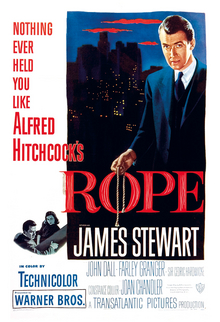
Cutting Edges - Rope (1948) - Film Review

Constructed entirely from uncut ten-minute shot, Rope (1948) is one of Alfred Hitchcock’s more experimental films even though it didn’t work out. “Alfred Hitchcock called Rope an ‘experiment that didn’t work out’, and he was happy to see it kept out of release for most of three decades. Rope remains one of the most interesting experiments ever attempted by a major director working with box-office names, and it’s worth seeing [...].” (Roger Ebert, 1984).

Rope2.jpg

Rope’s argument is about the Nietzschean philosophy between a couple of students and their professor. Hitchcock also plays with situations involving the inconvenience of dead bodies; but this doesn’t make the film successful: “Also the emphasis on the macabre in this small story is frightfully intense. And it seems to this public observer that time could be better spent than by watching a waspish cocktail party in a room with a closely present corpse, placed there by a couple of young men who have killed for a thrill and nothing more.” (Bosley Crowther, 1948).
It starts with Brandon (John Dall) and Phillip (Farley Granger) who are two young college students who want to prove their intellectual superiority. So they kill their friend David Kentley (Dick Holan) and hide his body in an unlocked trunk where a party is taking place and dinner is going to be served. The guests of this party are David’s father Mr. Kentley (Cedric Hardwickle), his aunt Mrs. Atwater (Constance Collier), his fiancée Janet (Joan Chandler), his best friend Kenneth (Douglas Dick) and their college professor Rupert Cadell (James Steward). They are all aware of what has happened. But their professor starts to suspect and he finally discovers that Brandon and Phillip have killed David.


The strong performance from Dall, Granger and Steward creates drama and suspense. But, as Bosley Crowther of The New York Times said, “the novelty of the picture is not in the drama itself, it being a plainly deliberate and rather thin exercise in suspense, but merely in the method which Mr. Hitchcock has used to stretch the intended tension for the length of the little stunt for a story of meager range” (Bosley Crowther, 1948). The camera follows the killers wherever they go, their goings and their comings, so it seems as if they are caught.
Hitchcock had to deal with time and space. This means that there can’t be jumps in time, or the suspense will be lost. The audience must know that the body is always in the trunk. The play is an 80 minutes scene taken in ten minutes long segments. It was not edited and there are not visible cuts between the segments. It seems as if all the events take place in one uninterrupted act, as a continuous shot. And this is why Alfred Hitchcock’s Rope is well known for.

Illustration list:
Figure 2. Rupert, Brandon and Phillip [Film Still] At: http://www.jasonbovberg.com/hitchcock-conversations-rope-1948/

Bibliography:
Fernando F. Croce (2006) Rope At: http://www.slantmagazine.com/film/review/rope
Pamela Hutchinson (2012) My favourite Hitchcock: Rope At: http://www.theguardian.com/film/filmblog/2012/jul/27/my-favourite-hitchcock-rope

Bosley Crowther (1948) The Screen In Review; ‘Rope,’ an Exercise in Suspense Directed by Alfred Hitchcock, Is New Bill at the Globe At: http://www.nytimes.com/movie/review?res=980DE3D81630E03BBC4F51DFBE668383659EDE