Showing posts with label Film review. Show all posts
Showing posts with label Film review. Show all posts
Friday, 15 December 2017

Film Review | Character and Storytelling: Star Wars: The Force Awakens (2016)
“Star Wars: The Force Awakens is some kind of miracle. It works on every imaginable level - as a heartfelt love letter to fans, and an irresistible invitation to newbies, a visual marvel and blockbuster of unparalleled emotional heft and cultural significance” (Isaac Feldberg, We Got This Covered, 2016). Star Wars: The Force Awakens (2015) co-written and directed by J.J. Abrams is an epic space film about the Empire coming back as the First Order being stronger than before and seeks to eliminate the New Republic while the Resistance opposes them and try to find Luke Skywalker.

In this film, there are two main characters: the hero and the villain. The hero is Rey (Daisy Ridley), “Ridley is the picture’s real find. Her Rey is fearless, forceful, resourceful, and with a hidden side to her personality that slowly manifests itself and will surely be more deeply explored in the sequels” (Soren Andersen, The Seattle Times, 2015). Rey is a young woman who grew up alone in the desert wastes of Jakku thinking that her family will come back for her. Is at this moment when she meets BB-8, and her journey as a hero starts. During all this journey she discovers a lot of things about herself being probably the most important one the fact that she discovers her latent Force-sensitivity. At the beginning of the movie, she doesn’t have any goals, but at the end, her main goal is to find Luke Skywalker by herself. This is only the beginning for her as Kylo Ren (Adam Driver) said “She’s just beginning to test her powers. The longer it takes to find her, the more dangerous she becomes.”

On the opposite side, Kylo Ren is the villain. Kylo Ren is the son of Princess Leia Organa and General Han Solo, and before he joined the First Order (the dark side), he was a Force warrior and a former Jedi trained by his uncle, Luke Skywalker. Even though Princess Leia hoped he could be saved and left the dark side, in a confrontation with Han Solo, Ren kills him. And this demonstrates that he doesn’t care about his family, the only thing that matters to him is himself and his goals. His main goal is to finish what his grandfather (Sith Lord Darth Vader) started: the elimination of the Jedi.
Bibliography:
Soren Andersen (2016) Review of ‘Star Wars: The Force Awakens’: This new alliance is strong At: https://www.seattletimes.com/entertainment/movies/star-wars-the-force-awakens-this-new-alliance-is-strong/ Accessed on: 15/12/2017
Isaac Feldberg (2016) Star Wars: The Force Awakens Review At: http://wegotthiscovered.com/movies/star-wars-force-awakens-review/ Accessed on: 15/12/2017
Illustration List:
Image 1. Star Wars: The Force Awakens [Film Poster] At: http://www.starwars.com/news/star-wars-the-force-awakens-theatrical-poster-first-look-in-theater-exclusives-and-more Accessed on: 15/12/2017
Image 2. Star Wars: The Force Awakens [Film Still] At: https://www.seattletimes.com/entertainment/movies/star-wars-the-force-awakens-this-new-alliance-is-strong/ Accessed on: 15/12/2017
Film Review | Exploitation Cinema: Mad Max: Fury Road (2015)
Mad Max: Fury Road
(2015), directed by the filmmaker George Miller “delivers the sort of
jumbo-sized entertainment that makes you spontaneously break out in
appreciative laughter: The breadth of his imagination and showmanship makes you
giddy” (Rene Rodriguez, Miami Herald, 2015). Full of destruction, violence and
weird scenes, Mad Max is a prison escape post-apocalyptic action adventure
film.

Mad Max is also
part of the exploitation cinema where the main themes are sex, romance,
eroticism, violence, crimes, and drugs. The exploitation and the abuse are
represented by the two antagonists: Furiosa (Charlize Theron) who is a feminist
hero, and the Immortal Joe (Hugh Keays-Byrne) who is an evil leader of war boys
and woman sex slaves.
The whole film is
about Mad Max helping the hero of the story, Furiosa, to free a group of young
women sex slaves from the Immortal Joe. This can be understood as a feminist
revolution as all of these women are fighting against their oppressor without
taking care what they look like and if there are any chances to win. A woman
can be heroic too, and they can also fight for themselves and the rest of
society. Max’s role is quite important though because he is not the hero even
though he is also fighting, and his behavior transmits that violence doesn’t
make him more masculine as the Immortan Joe does.

“Mad Max: Fury
Road will leave you speechless, which couldn’t be more appropriate. Words are
not the point when it comes to dealing with this barn-burner of a
post-apocalyptic extravaganza in which sizzling, unsettling images are the
order of the day” (Kenneth Turan, Los Angeles Times, 2015). So in conclusion,
even though this fantastic film will leave you speechless, it is an
exploitation film, and women are shown as sexual objects, and it mainly
represents how women are getting more and more powerful. And that also
describes today’s society where women can be the hero too.
Bibliography:
Kenneth Turan
(2015) ‘Mad Max’ kick a post-apocalyptic extravaganza into overdrive At:
http://beta.latimes.com/entertainment/movies/la-et-mn-mad-max-review-20150515-column.html
Accessed on: 15/12/2017
Illustration List:
Image 1. Mad Max:
Fury Road [Film Poster] At:
https://www.imperialcinema.co.uk/films/mad-max-fury-road/ Accessed on:
15/12/2017
Image 2. Mad Max:
Fury Road [Film Still] At:
http://beta.latimes.com/entertainment/movies/la-et-mn-mad-max-review-20150515-column.html
Accessed on: 15/12/2017
Film Reviews | Adaptation: The Beauty and The Beast (2017)
Beauty and the
Beast (2017), directed by Bill Condon, is a live-action re-telling film of a
fantastic Disney’s fairy tale.

The story is about
Belle, a beautiful and independent woman who, because of saving his father, is
taken as a prisoner by a beast in his castle. There she befriends the castle’s
enchanted staff, and despite her fears, she gets to know the beast and realizes
the true colors of the Prince.
What was it
adapted from?
It was adapted
from Disney’s musical romantic fantasy animated film directed in 1991 by Gary
Trousdale and Krik Wise. This 1991 Beauty and the Beast movie stayed true to a
French fairy tale written by Jeanne-Marie Leprince de Beaumont and called The
Beauty and the Beast too, and it was also based on a 1946 French film directed
by Jean Cocteau and also named the same way.
Did it omit
anything to the source material?
Not at all, “The
Mouse House has taken no such chances with Beauty and The Beast. The plot, the
characters, the cheerful Howard Ashman and Alan Menken tunes: all have been
faithfully recycled, as though some enchantress has waved her wand over an old
cartoon and suddenly brought it screaming into the flesh-and-blood world” (A.A.
Dowd, AV Film, 2017).
Did it add
anything to the source material?
Nothing, Disney’s
tale as old as time doesn’t feel new, and it is that oldness the great point
about the film.

How did it bring
the source material to life visually?
Visual effects
everywhere. But as the effects company Digital Domain said, creating the character
of the Beast was the most prominent challenged mainly because it is “a digital
creation based on a performance by “Downton Abbey” star Dan Stevens”. “Often
actors wearing motion capture suits wear camera rigs on their heads and have
tracking points marked on their faces too. But it was decided that Stevens and
co-star Emma Watson should be able to see each clearly to interact more
realistically, so Stevens didn't wear a head-mounted camera. Instead, after
shooting a scene on set with the other actors, he would go into a studio at a
later date to record the second part of his performance. Those thousands of
tracking points were then mapped to the digitally-created face of the Beast,
transferring the nuances of Stevens' performance to the outlandish creature”
(Richard Trenholm, CNet, 2017)
Did it succeed or
fail at the box office?
That's a yes! “
Meanwhile, the Beauty and the Beast earned $490.6 million domestically (and
counting) in its first week in theaters, while its international box office had
swelled to $262 million as of Friday. Adjusted for 2017 rates, the 1991 film’s
haul is more like $760 million - but the new Beauty is expected to surpass that
figure as well before long” (Yohana Desta, Vanity Fair, 2017).
Bibliography:
A.A. Dowd (2017)
Why remake Beauty And The Beast and do nothing new with its tale as old as
time? At:
https://film.avclub.com/why-remake-beauty-and-the-beast-and-do-nothing-new-with-1798190749
Accessed on: 15/12/17
Richard Trenholm
(2017) Beauty of the Beast: The cutting-edge effects behind Disney’s hit At:
https://www.cnet.com/news/beauty-and-the-beast-visual-effects-digital-domain-dan-stevens-emma-watson/
Accessed on: 15/12/17
Yohana Desta
(2017) How Beauty and the Beast Became One of Disney’s Most Profitable Gambles
At: https://www.vanityfair.com/hollywood/2017/03/beauty-and-the-beast-animated-box-office
Accessed on: 15/12/17
Illustration List:
Image 1. The
Beauty and the Beast [Film Poster] At:
http://www.impawards.com/2017/beauty_and_the_beast_ver3.html Accessed on: 15/12/17
Image 2. The
Beauty and the Beast [Film Still] At:
http://www.news.com.au/entertainment/movies/your-childhood-comes-to-life-in-the-first-trailer-for-disneys-beauty-and-the-beast-starring-emma-watson/news-story/0497a8c0116a42afcd20b5ba6eb1c163
Accessed on: 15/12/17
Film Review | The Hero's Journey: UP
The story starts with a storyline meeting Carl, the hero of this story,
and Ellie, his wife. After Ellie dies, Carl has to live alone in their house.
And here it is when his hero’s journey begins.

The Call to Adventure is when there is a construction project
around Carl’s house, and the construction company wants Carl to leave his
house, something he doesn’t want to do mainly because his house is his comfort
zone, his everything. Carl refuses that call (Refusal of Call) when he
starts to have problems with the construction company. Carl loses his house to
a lawsuit and is sent to a retirement home to live there for the rest of his
life. Before he leaves, he finds his childhood book and realizes that he still
has not been able to go to Paradise Falls. Then, Carl meets Russel, a
wilderness explorer who wants to help him, and that is the Supernatural Aid.
Even though Russel is just a kid, he is Carl’s mentor because he is the one who
forces Carl to be the hero. But at first, Carl denies any help from Russel.
Crossing the First Thresholds is when Carl attaches helium
balloons to his house and flies through the sky. Once his house is lifted up,
there is no going back. Then he realizes Russel is still in his house and
decides to take him back home, but there is a thunderstorm where Carl has a
near-death experience (Belly of the Whale). Carl wakes up in South
America, being far away from the Paradise Falls.

The Road of Trials starts when Carl struggles to get his house to
Paradise Falls and also has to deal with Russell, Kevin (the Paradise Falls
bird), Dug (Charles Muntz’s dog) and Charles Muntz (Carl’s childhood hero, who
is also the villain of the movie). Charles hunts Kevin and Russel decides to
save him but gets caught too.
Before Carl decides to go to save Rusell and Kevin, he goes inside his
house and sees a photo of Ellie, and that is the Meeting the Goddess.
Ellie did not do much to help Carl, but she somehow encourages him as she is
essential for Carl.
Temptation is when Carl only thinks about getting his house in
the Paradise Falls without thinking about Kevin and the others.
The Atonement with the Father is Russell telling Carl a story
about counting cars with his father, which even though it seems to be boring,
that is one of the things he loves the most basically because of doing it with
someone he loves. Carl realizes that Russel is just a lonely boy seeking for
love and attention because it’s something he doesn’t get from his dad. The Apotheosis
comes along when Rusell decides to save Kevin by his own but he gets captured
too, and Carl discovers that even though Ellie didn’t achieve her dream of
living next to the Paradise Falls, her greatest adventure was her relationship
with Carl. She somehow encourages Carl to continue having adventures.

The Ultimate Boon is when Carl decides to go after Muntz throwing
out all the excess of weight and getting his house back in the air. He is ready
to go ahead on the final challenge with excitement and determination. Once his
house is lifting up leaving all his belongings there, there is not going back,
and that is the Refusal of Return. The Magic Fight is Carl’s
fight with Muntz as he tries to rescue Rusell, Kevin, and Dug. As Carl is about
to be killed by Muntz, Dug saves him being this the Rescue from Without.
Then Carl goes back to home with Russel and Dug (Crossing the Return
Threshold). Master of Two Worlds is when apart from achieving the
dream of having his house in the Paradise falls, he has also achieved happiness
by living in the present and not in the past anymore. And finally, the Freedom
to Live is when he sits on the sidewalk counting cars with Russel,
something boring but better than a wild adventure because he is with someone he
loves.
Illustration List:
Figure 1. Up (2009) [Film Poster] At:
https://en.wikipedia.org/wiki/Up_(2009_film) Accessed on: 15/12/2017
Figure 2. Up (2009) [Film Still] At:
http://bgr.com/2016/06/17/pixar-shorts-movie-list-supercut/ Accessed on:
15/12/2017
Figure 3. Up (2009) [Film Still] At:
https://www.odt.co.nz/entertainment/film/film-review Accessed on: 15/12/2017
Friday, 13 January 2017
Film Review | Explotation Cinema | Mad Max: Fury Road
Mad Max (2015), directed by the filmmaker George Miller, a story based on a post-apocalyptic action adventure full of violence, destruction, and fast cars sequences, as well as some other disturbing images but "even in the most chaotic fights and collisions, everything makes sense. This is not a matter of realism – come on, now – but of imaginative discipline. And Mr. Miller demonstrates that great action filmmaking is not only a matter of physics but ethics as well. There are cause and effect; there are choices and consequences" (A.O. Scott, The New York Times, 2015).
| Mad Max: Fury Road [Poster] |
This film review will not only be about Mad Max: Fury Road but also about the exploitation cinema. The exploitation film consists of low-quality B movies that try to success financially because of exploiting morally unacceptable and trend themes. They are usually about eroticism, sex, romance, drugs, crimes, and violence.
The oppressive violence and exploitation are the two themes that Fury Road is basically about, and it shows through the antagonists of the movie: the evil leader called Immortan Joe (Hugh Keays-Byrne) and his war boys. The whole movie is about a prison escape.
One of the main characters is Furiosa (Charlize Theron). Furiosa is the feminist hero. She is freeing a group of young women who are Immortan Joe's sex slaves from his prison. There is also the fact that those female prisoners are dressed in lingerie like if they were supermodels and even though they look like supermodels that do not stop them from fighting against their oppressor. Although there is a like a kind of refusal to treat the women prisoners as good, this can also be understood as a feminist revolution.
| Mad Max: Fury Road [Film Still] |
In Fury Road, the women are kind of blameless, and this is when Max (Tom Hardy) appears. Max, chase by the image of his daughter, is exiled from society until he gets as a prisoner and also tries to escape from Immortan Joe's prison. Max's role in the movie helps the women; this is like women can be heroic too and can save each other by their own, but there is still a man who sacrifices himself to save women. In Fury Road, men sometimes help women, or they are love interests or villains, but they are never heroes. Even though Max is not the hero he sometimes acts as if he is, and he also demonstrates many masculine qualities, but those qualities are never pushed to extreme limits as Immortan Joe and the war boy do. Max's behavior communicates that masculinity itself is not what creates destruction or oppression. Instead of that, Max has the control of the situation and triumphs as the critic Ian Nathan says, "Max's re-enfranchisement is a triumph of barking-mad imagination, jaw-dropping action, crackpot humour, and acting in the face of a hurricane" (Empire, 2015).
| Mad Max: Fury Road [Film Still] |
The critic Richard Roeper said, "It's all perfectly, wonderfully, fantastically crazy. Amidst all those ingenious, power-packed road warrior sequences, Fury Road contains a surprising amount of depth and character development" (Chicago Sun-Times, 2015). So, in conclusion, Mad Max: Fury Road is a fantastic film whose characters have real strength. It is also a clear example of how B movies have an influence on today's films, and how even though it is an exploitation film where women are used as sexual objects, women can be the hero too, not just for her selves but also for the rest of the society.
Bibliography:
Berlatsky, Noah (2015) "Mad Max: Fury Road is less radical that its B-movie influences" At: https://www.theguardian.com/film/2015/may/26/mad-max-fury-road-less-radical-exploitation-influences Accessed on: 13/01/2017
Flicks, Bitch (2015) "Mad Max: Fury Road" Allows Audiences to Both Enjoy and Problematize Hypermasculinity At: http://www.btchflcks.com/2015/06/mad-max-fury-road-allows-audiences-to-both-enjoy-and-problematize-hypermasculinity.html#.WHi--vnJzIU Accessed on: 13/01/2017
Lane, Anthony (2015) "Mad Max: Fury Road" At: http://www.newyorker.com/magazine/2015/05/25/high-gear-current-cinema-anthony-lane Accessed on: 13/01/2017
Illustration List:
Figure 1. Mad Max: Fury Road (2015) [Film Poster] At: https://www.rottentomatoes.com/m/mad_max_fury_road/ Accessed on: 13/01/2017
Figure 2. [Film Still] At: https://www.rottentomatoes.com/m/mad_max_fury_road/ Accessed on: 13/01/2017
Figure 3. [Film Still] At: https://www.rottentomatoes.com/m/mad_max_fury_road/ Accessed on: 13/01/2017
CG Artists Toolkit and Film Review Submission
CG Artists Toolkit (Maya Tutorials)
3) Pipeline 1: Head Modelling
4) Pipeline 1: Body Modelling
5) In Class Animaton: Animated Sequence
7) 2D Character Rigging
Film Reviews
2) Archetypes & The Hero's Journey
3) Narrative Theory & Film Structure
4) Narrative & Character
5) Quality Part 1: B-Movies
7) Documentary & Mockumentary
8) Adaptation & Transcription
9) Comedy & Slapstick
Tuesday, 6 December 2016
Film Review | Myth & The Hero's Journey | Toy Story
Do
you really think toys become “real” when humans are not around? Toy Story (1995), a family film directed
by John Lasseter, follows the adventures where toys live in a secret life (they
are real) when people are not there. Its main characters are an out of fashion
cowboy toy and the awesome and new space ranger toy who wants to replace him as
Andy’s favourite toy. And they both have a common villain, the kid who lives
next door. All this makes Toy Story
“A visionary roller-coaster ride of a movie” as Roger Ebert says on his webpage
crit.
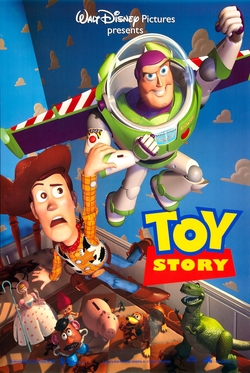 |
| Image 1 - Toy Story Poster |
This
film review is not only about Toy Story
itself, but also about the Hero’s Journey. The Hero’s Journey is what makes a
good story and is one of the best resources for writers. It was written by
Christopher Vogler and it is about 17 different steps that are on each phase of
the hero.
This
film review will be about the hero’s journey related to Toy Story. This film is a good example because, even though it
doesn’t have every step exactly like the Hero’s Journey outlines, it is very
close. There is no just one hero, there are two. Woody and Buzz are the main
characters and also the heros. They both have to go on this emotional journey:
Woody has to deal his fears of having to share Andy, and Buzz has to learn what
the real world is like and that he is just a toy. So, during the movie they
combine and flip the stages of the hero’s journey between them.
The
movie starts with the first stage: “The Ordinary World”. “The ordinary world”
is the world where Andy and the toys live. The toys come to life when Andy is not
around. They live free, happily and comfortably.
But
then, something new arrives to change “the ordinary world”, and this is the
next stage: the “call to adventure”. It is Andy’s birthday party and he gets a
new present - Buzz Lightyear – the newest, coolest Space Ranger Hero toy. Buzz replaces
Woody as Andy’s favourite toy. Woody – the Old West sheriff toy - tells himself
that this new toy is not going to change anything.
Woody’s
“refusal of the call” is about fear. Woody refuses the call of adventure when
he thinks that Buzz isn’t the coolest toy and he believes that he is still
Andy’s favourite toy. But everything has change and even though Woody tries to
keep his authority, Buzz disrupts the ordinary world they were living in, and
make the other toys being eager to be his friend and find more about him.
 |
| Image 2 - Film Still |
About
the “supernatural aid”, this is not much seen in Toy Story though they both take
sometimes that role. Woody mentors Buzz and shows him around the world of the
toys. And always through an indirect way, there are some other moments where
Buzz becomes Woody’s mentor as he teaches Woody that he will still be loved
even if someone else holds the rank of “Andy’s Favourite Toy”.
“Crossing
the Threshold” is one of the most important steps and it happens when the
adventure begins. Woody and Buzz are the main heroes because they go on in
their adventure and in this case Buzz and Woody begin their adventure going out
of the window as a result of an accident. So, they are both in this new scary
world.
The
next step is the “Belly of the Whale” and it happens when they have to fight
out some battles. In this case, Buzz and Woody get into the arcade game where
they find their new friends. They are meeting new people in their adventure.
This phase is about what this other world is about.
The
“Road of Trials” is when the main characters have to face even more battles.
Woody is desperately trying to achieve his goal, which is getting back home to
Andy. And Buzz refuses being just a toy. They also get in trouble because of
Sid, the bad kid of the neighbourhood.
“Meeting
with the Goddess” is the reversal of the Goddess. Sid is the opposite of the
Goddess as he is always torturing toys. And this is the moment when they
realize that they really need to get out of this situation.
Buzz’s
“Temptation” (“Woman as Temptress”) is when he tries to give up his life. Buzz
realizes that Woody was all right and he is just a toy. And Woody has his
“Atonement with the Father” when he realizes that his pride has led to his
fall. He has been abandoned by his friends because of being jealous and
selfish. And he has also lost Andy because he is about to die.
But
they didn’t give up. The “Apotheosis” is when Woody, Buzz and other Sid’s toys
fight the main battle. They break the rules and come to life in front of Sid.
After they fight out the main battle and get out of Sid’s yard, Woody and Buzz
reconcile and this is the “Ultimate Boon”. They start working together as a
team.
But
there is still a long way to go, and this is the next point: “The Magic Fight”.
Woody and Buzz are going back home. They see Andy’s moving truck and they chase
it.
 |
| Image 3 - Film Still |
Woody
and Buzz realize that they need friendship. Woody also realizes that Buzz is
not just a toy and he can do something more. And this is the “Rescue from
Without”: Buzz uses his retractable wings to fly and catch Andy’s car. Woody
and Buzz “Cross the Return Threshold” when they get into Andy’s car and Andy is
happy because he has found them again. “The Master of Two Worlds” is when they
all arrive at Andy’s new home.
And
finally, the last step is “Freedom to Live”. It is Christmas and Andy is
opening new toys. Woody and Buzz are happy to be friends. Buzz seems to be
quite nervous because of the idea of being replaced as Andy’s favourite toy,
and Woody is relaxed as he knows that he is still loved even if Andy has more
than one favourite toy.
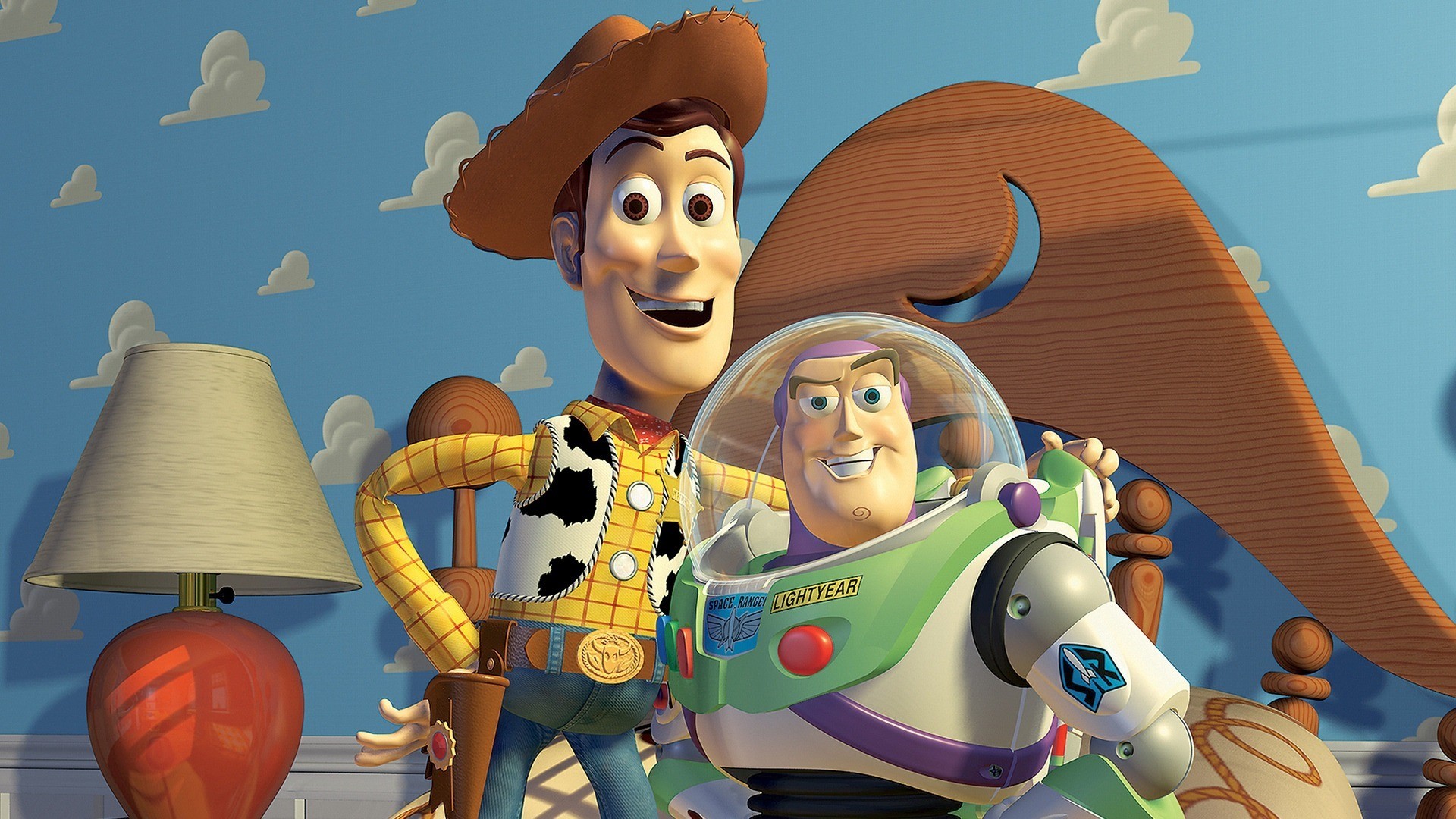 |
| Image 4 - Film Still |
This
81 minute running time story was the first Pixar feature film animated entirely
by computer. Roger Ebert said: “Watching the film, I felt I was in at the drawn
of a new era of movie animation, which draws on the best of cartoons and
reality, creating a world somewhere in between, where space not only bends but
snaps, crackles and pops”. This means that it is a film where the characters
are done in three-dimensions and they seem to be quite real, which is something
that the traditional drawing cannot fully achieve.
Toy Story is an all audience hyperrealist film
where imagination is an important part of a kid’s playtime: “It’s that the
rarest of all films, the one that can unify, not divide, the generations, as
both teenagers and their more innocent parents can connect with it. And of
course for the kids, it’s pure balm from heaven” (Stephen Hunter, Baltimore
Sun, 1995).
In
conclusion, Toy Story is an amazing
film where characters demonstrate loyalty, courage and teamwork. Still
recommended nowadays, and still having a long way ahead as Buzz Lightyear’s
most memorable quote says: “To infinity and beyond”.
Bibliography:
Ebert,
Roger (1995) “Toy Story” At: http://www.rogerebert.com/reviews/toy-story-1995 Accessed on: 04/12/2016
Hunter,
Stephen (1995) “Toy Story looks funny,
feels great Movie review: Computer wizardry is the least of this delightful
movie’s pleasures”. At: http://articles.baltimoresun.com/1995-11-22/features/1995326035_1_toy-story-graf-zepplin-meets-toy Accessed on: 04/12/2016
Minow,
Nell (2003) “Toy Story (1995)” At https://www.commonsensemedia.org/movie-reviews/toy-story-1995# Accessed on: 04/12/2016
Illustration
list:
Figure
1. Toy Story (1995) [Film Poster] At: http://www.disney.co.uk/toy-story/pictures Accessed on: 04/12/2016
Figure
2. [Film Still] At: http://thestorydepartment.com/structure-toy-story-1/
Accessed on: 04/12/2016
Figure
3. [Film Still] At: http://toystory.disney.com/ Accessed on: 04/12/2016
Figure
4. [Film Still] At: http://www.disney.co.uk/toy-story/pictures Accessed on: 04/12/2016
Thursday, 28 April 2016
Cutting Edges - The Sixth Sens (1999) - Film Review
The Sixth Sense (1999) is
an American production which caused a great impact on the audience, being the
best film by screenwriter and film director M. Night Shyamalan.

Shyamalan’s The Sixth Sense stands out because of
its simple shots, because of its simple but at the same time complex story, and
because of the excellent main characters. Apart from Bruce Willis, the movie
stars Haley Joel Osment, who has made
maybe the greatest performance ever by a child actor. “The 11-year-old Osment
evokes the boy’s terror and awful predicament so memorably, you’ll never forget
him” (Desson Howe, 1999)
The story begins with Bruce
Willis in the role of Dr. Malcolm Crowe. Crowe is a child’s psychologist who
lives completely to his job, and despite his great achievements he is obsessed with
the painful memory of a young patient he was unable to help. Several months
later, Crowe has a chance to help Cole (Haley Joel Osment), a terrified and
confused eleven year old boy whose background reminds him of his only case
failed. Meanwhile, Crowe’s private life is a mess, and his marriage with Anna
(Olivia Williams) turns out to be a cold and a distant relationship, and he cannot
do anything to solve it.

“The Sixth Sense has a kind of calm, sneaky self-confidence that
allows it to take us down a strange path, intriguingly” (Roger Ebert, 1999). Its
powerful atmosphere and also the narrative way in which it is written, makes
the film have like a second dimension. A second dimension where Shyamalan shows
the audience the pure essence of fears and how terror makes people blocked and
unable to find a solution. And everything is set up in places where the tension
and the suspense are quite important. “Writer-director M. Night Shyamalan lets
the tension rise slowly, leads you everywhere you don’t expect, doesn’t rip you
off and totally freaks you out – all without stale effects or gone” (John
Patterson, L.A. Weekly)
There are some different
topics the film is about, such as a lonely childhood, the difficulty of being a
single mother, and the frustration of losing a marriage because of one’s job. But
it is also a film where nothing is what it seems to be, being the fear the main
topic of the whole film. The film shows things adults cannot see. It is said that children are better than adults at
seeing ghosts. Cole’s problem is that he can see dead people everywhere, but
they don’t even know they are dead and they cannot see each other. And the solution for all the topics given
before is communication. Communication with the family, friends and also with
strangers.
In conclusion, The Sixth Sense is an extraordinary
suspense drama and a psychological thriller developed in an extraordinary way.
It also has one of the best endings in the history of thrillers.
Bibliography:
Desson Howe (1999) A Chillingly Intense ‘Sense’ At: http://www.washingtonpost.com/wp-srv/style/movies/reviews/sixthsensehowe.htm Accessed on: 17/04/2016
Roger Ebert (1999) The Sixth Sense At: http://www.rogerebert.com/reviews/the-sixth-sense-1999 Accessed on: 17/04/2016
Stephen Holden (1999) A Boy Who Sees the Dead, and a Psychologist
Determined Not to Fail Him At: http://www.nytimes.com/movie/review?res=9802E3DB1430F935A3575BC0A96F958260 Accessed on: 17/04/2016
Illustration list:
Image 1. The Sixth Sense Poster At: http://www.fanpop.com/clubs/the-sixth-sense/images/36136397/title/sixth-sense-poster-photo Accessed on: 17/04/2016
Image 2. Cole and Crowe talking At: http://whatsonnetflix.com/what-to-watch/the-sixth-sense/ Accessed on: 17/04/2016
Wednesday, 3 February 2016
Cutting Edges - Rope (1948) - Film Review
Constructed entirely from
uncut ten-minute shot, Rope (1948) is one of Alfred Hitchcock’s more
experimental films even though it didn’t work out. “Alfred Hitchcock called Rope an ‘experiment that didn’t work
out’, and he was happy to see it kept out of release for most of three decades.
Rope remains one of the most
interesting experiments ever attempted by a major director working with
box-office names, and it’s worth seeing [...].” (Roger Ebert, 1984).
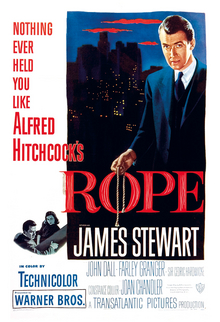
Rope’s argument is about the Nietzschean
philosophy between a couple of students and their professor. Hitchcock also
plays with situations involving the inconvenience of dead bodies; but this
doesn’t make the film successful: “Also the emphasis on the macabre in this
small story is frightfully intense. And it seems to this public observer that
time could be better spent than by watching a waspish cocktail party in a room
with a closely present corpse, placed there by a couple of young men who have
killed for a thrill and nothing more.” (Bosley Crowther, 1948).
It starts with Brandon (John
Dall) and Phillip (Farley Granger) who are two young college students who want to
prove their intellectual superiority. So they kill their friend David Kentley
(Dick Holan) and hide his body in an unlocked trunk where a party is taking
place and dinner is going to be served. The guests of this party are David’s
father Mr. Kentley (Cedric Hardwickle), his aunt Mrs. Atwater (Constance
Collier), his fiancée Janet (Joan Chandler), his best friend Kenneth (Douglas
Dick) and their college professor Rupert Cadell (James Steward). They are all
aware of what has happened. But their professor starts to suspect and he
finally discovers that Brandon and Phillip have killed David.

The strong performance from
Dall, Granger and Steward creates drama and suspense. But, as Bosley Crowther
of The New York Times said, “the novelty of the picture is not in the drama
itself, it being a plainly deliberate and rather thin exercise in suspense, but
merely in the method which Mr. Hitchcock has used to stretch the intended
tension for the length of the little stunt for a story of meager range” (Bosley
Crowther, 1948). The camera follows the killers wherever they go, their goings
and their comings, so it seems as if they are caught.
Hitchcock had to deal with
time and space. This means that there can’t be jumps in time, or the suspense
will be lost. The audience must know that the body is always in the trunk. The
play is an 80 minutes scene taken in ten minutes long segments. It was not
edited and there are not visible cuts between the segments. It seems as if all
the events take place in one uninterrupted act, as a continuous shot. And this
is why Alfred Hitchcock’s Rope is
well known for.
Illustration list:
Figure 1. Rope [Poster] At: https://en.wikipedia.org/wiki/Rope_(film)#/media/File:Rope2.jpg
#/media/File:Rope2.jpg)
Figure 2. Rupert, Brandon and Phillip [Film Still] At: http://www.jasonbovberg.com/hitchcock-conversations-rope-1948/
Bibliography:
Fernando F. Croce (2006) Rope At: http://www.slantmagazine.com/film/review/rope
Pamela Hutchinson (2012) My favourite Hitchcock: Rope At: http://www.theguardian.com/film/filmblog/2012/jul/27/my-favourite-hitchcock-rope
Bosley Crowther (1948) The Screen In Review; ‘Rope,’ an Exercise in
Suspense Directed by Alfred Hitchcock, Is New Bill at the Globe At: http://www.nytimes.com/movie/review?res=980DE3D81630E03BBC4F51DFBE668383659EDE
Saturday, 12 December 2015
Film Review - King Kong
King Kong (1933) was directed by Merian. C Cooper and Enerst B.
Schoedsak , and it is undoubtedly the most famous monster movie in history ,It
could be argued that King Kong founded this genre . It also belongs to the
genre of lost worlds though.

King Kong is about a group of people who follow the orders of Carl
Denham, an adventurous filmmaker. They go to an island in the middle of the
Pacific to make a film recording the natives of the place and the mysterious
giant ape called Kong. But the natives of the area discover them and kidnap Ann
Darrow, who is the heroine in Denham's film , to offer her as a sacrifice to
Kong. The huge monkey kidnaps her and the entire crew of the boat set out to
her rescue. John Driscoll rescues Ann and they are both pursued by Kong. Denham manages to capture the monkey and takes
him to New York to make it a show.
Talking about the camara plans, sometimes there are close-ups of the ape that appear to
have been made with a giant model. This means that instead of provoking
amazement, it causes laughter, due to its low gesticulation . At the time the movie was filmed, the
director had to use every possible resource on the book and even invent new
ones, mostly for the special effects. Matte paintings of trees in the jungle
were required, as well as miniature sets, which were put in layers of more
miniature model trees. Composite photography was also used along with rear
screen projection and an invention for this film, front projection, a technique
in which a miniature film can be projected onto a miniature set while doing
stop motion work.

King Kong is based on The Beauty and the Beast but in the Beauty and the
Beast there is a romance, King Kong doesn't comes from a romance. The only
thing there is the obsession Kong has with Ann. Ann is nothing more than a nice
toy throughout the movie , which makes the role of the woman a screaming and
waiting for rescue one. But it's not only Ann’s character that lacks something,
the other characters seem to have no personality either.
But the best thing about this movie is that causes the spectator not to
miss a minute . And besides being incredibly innovative , it is also very
violent : Kong brutally destroys its victims.

I would recommend this movie to anyone who is interested in seeing how
the genre has changed over the time. King Kong may not be a masterpiece in terms
of acting and special effects from today’s perspective, but it certainly is a
piece of history in stop motion animation. The special effects have changed a
lot but it is incredible how the ones used in King Kong have held up and how
today’s viewer gets still engaged with the movie. A definite must see.
Illustration list:
Figure 1: Film Poster. At: https://es.wikipedia.org/wiki/King_Kong_(pel%C3%ADcula_de_1933)
Figure 2: Kong in New York. At: http://www.filmfreakcentral.net/ffc/2012/05/king-kong-1933-digibook-blu-ray-disc.html
Figure 3: Kong and Tyrannosaurus fighting. At: http://horrorpedia.com/2014/09/16/king-kong-1933/
Bibliography:
Fogs’ Movie Reviews, (2013) At: http://fogsmoviereviews.com/2013/02/04/movies-that-everyone-should-see-king-kong/
Subscribe to:
Posts (Atom)